
Summary · 8 min read
How to advertise a new product that nobody searches for starts with creating demand, not capturing it. Use Demand Gen and YouTube first, measure brand search lift, then scale search and Performance Max once real demand appears in results.
- Search ads capture demand; they cannot create it from nothing.
- Launch order: Demand Gen and video first, search campaigns later.
- Track brand search lift and remarketing audiences, not just sales.
If you are wondering how to advertise a new product and your Google Ads search campaigns are barely getting any impressions, the ad itself is rarely the problem. Nobody searches for something they do not know exists yet.
This is a familiar scene for founders across Europe, where a third of EU enterprises now advertise online. Stock is sitting in the warehouse, the launch budget is approved, and Google Ads keeps flagging low search volume, which is exactly why working out how to advertise a new product feels harder than it should. The few impressions you do get come from broad, unrelated queries.
The cost is not just wasted clicks. It is cash tied up in stock, pressure on cash flow, and weeks lost to trial and error while the launch window closes, which shows why knowing how to advertise a new product before demand exists matters, especially since most new product launches fail to meet their goals.
How to advertise a new product with zero search volume
Google Ads will not show search ads when almost nobody types the keywords you have chosen. The direct answer to how to advertise a new product that has zero search volume is simple: a search campaign only appears when someone actively looks for something related to it, and if the product, brand or category is new, that search does not exist yet.
A few other issues usually make this worse:
- Keywords built around the product or brand name, which nobody recognises yet.
- Internal jargon your team uses that customers never type.
- Broad match with no negative keywords, sending spend towards vague, irrelevant searches.
- A daily budget that is too low for the algorithm to gather enough data to learn.
- Poorly configured conversion tracking, leaving bidding strategies with no signal to work from.
Quick self-check
Answer yes or no:
- Does your ideal customer feel the problem your product solves, without knowing a solution exists?
- Are your highest-impression keywords generic and loosely related to the product?
- Have you spent more than half the launch budget without a clear conclusion?
- Do you not know how many people have searched for your brand since launch?
- Do you have no remarketing audience of meaningful size yet?
Two or more yes answers mean this is not an ad optimisation problem: you are trying to capture demand that has not been created yet.
Demand capture vs demand creation: what is the difference?
Demand capture means showing your offer to people who are already looking for a solution, typically through Google search ads. Demand creation means getting people who are not yet searching to recognise a problem and connect it to your brand, through video, visual formats and content shown to well-defined audiences.
Understanding this distinction is the first step in how to advertise a new product instead of just repeating what works for an established one. Both matter, but order matters more: in a market with established demand, search is usually the most efficient channel; for a product nobody searches for, search is the last step, not the first.
Search lift is the increase in searches for your brand or related terms that results from an advertising campaign. It is the clearest sign that advertising is creating demand, even before sales appear.
How to advertise a new product: the Create, Measure, Capture method
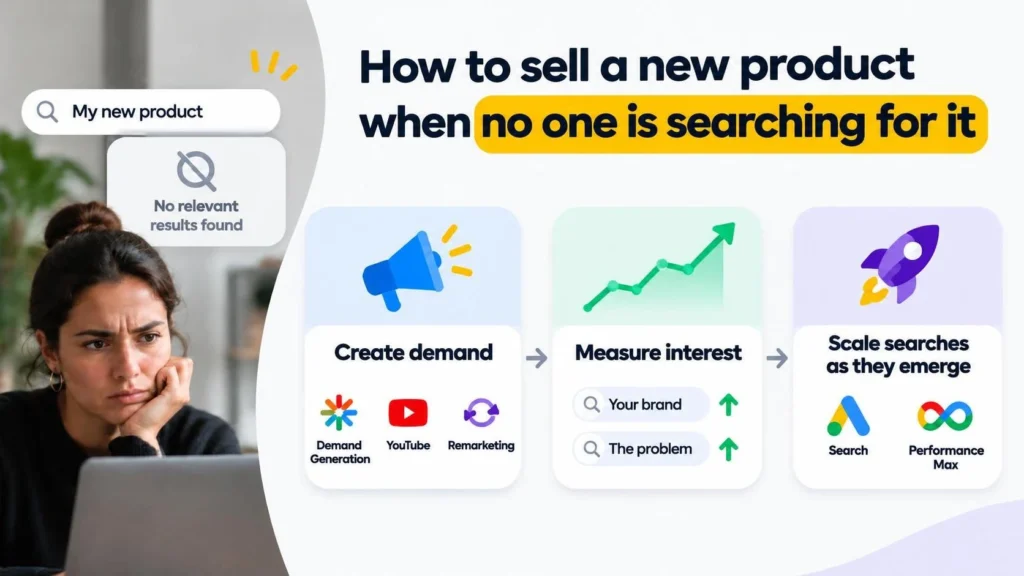
This is the practical framework behind how to advertise a new product without burning through your launch budget. It organises a launch into five sequential steps, each one feeding audiences and data into the next.
1. Name the problem your customer already feels
Your customer does not search for your product, but they do search for, feel or talk about the problem. Write the message around that problem, in their own words: “my back aches by the end of the day” or “quotes take me hours to prepare”. The product becomes the answer, not the starting point.
2. Launch Demand Gen and YouTube to the right audiences
Demand Gen campaigns serve visually engaging, multi-format ads across YouTube, YouTube Shorts, Discover and Gmail, to people who are not necessarily searching. They support product feeds and lookalike segments, meaning people similar to your past buyers, site visitors or video viewers. Start with two or three creative angles to test which message lands.
3. Build remarketing audiences
Anyone who watched most of a video, visited a product page or added to basket is no longer a stranger. Build remarketing lists from these people and show them more direct messages: social proof, guarantees, delivery terms, launch offers.
4. Track brand search and search lift
Track weekly searches for your brand name and for the words describing the problem. Demand Gen campaigns also support brand lift, search lift and conversion lift studies, which help you see whether the spend is shifting behaviour.
5. Scale search and Performance Max on the demand you created
Once brand and problem-related searches start appearing, it is time to launch or strengthen search campaigns and Performance Max. Real demand now exists to capture, and your remarketing audiences give the algorithm useful signals.
If you want to check whether this method fits your product before spending a euro on media, you can book a free consultation to review your launch plan.
Which campaign type should you use if nobody searches for your product?
Deciding how to advertise a new product starts with picking the right campaign type for where your audience actually is. A well-sequenced Google Ads for new product launch plan avoids exactly this trap. If nobody searches for your product, your main campaign type at the start should be Demand Gen or YouTube video, backed by remarketing; search campaigns come later, and Performance Max works best once you have conversion data to guide the algorithm.
| Campaign type | When to use | Intent level | What to measure | Launch risk |
|---|---|---|---|---|
| Search | When demand for the problem, category or brand already exists | High | Conversions, cost per sale, search terms | High if there is no search demand: few impressions or spend on irrelevant terms |
| Demand Gen | Early stage, to create demand with video, images and a product feed | Low to medium | Views, qualified visits, search lift, audiences built | Medium: needs strong creative and patience with attribution |
| Performance Max | Once conversions and audiences exist to guide the algorithm | Mixed | Conversions, conversion value, return on ad spend | High without data: little control and a tendency to spend where it is easiest |
| Meta Ads | Creating demand with audiences defined by interest and behaviour | Low to medium | Cost per visit, add to basket, sales, audiences | Medium: creative is decisive and ad fatigue arrives quickly |
This demand gen vs performance max choice is really a question of timing, not preference. Choosing between Google and Meta depends on your product and audience; our Google Ads and Meta Ads management covers both channels under one team, so budget can move quickly to whichever is working.
Budget, checklist and mistakes before you launch
Treating how to advertise a new product as a phased test, rather than a single bet, is what keeps product launch advertising cost under control. What does exist is a structure: treat the budget as a phased test, with milestones and a clear rule for stopping, adjusting or scaling.
| Phase | Goal | Decision at the end |
|---|---|---|
| Message test | Find which creative angle drives the most attention and qualified visits | Keep the two best creatives, cut the rest |
| Demand creation | Build audiences and start generating brand searches | Continue if searches and audiences grow; revisit the offer if they do not |
| Capture | Convert the demand created through search, remarketing and Performance Max | Scale if cost per sale sits within margin; stop or rework if it does not |
Before you spend a single euro, make sure the fundamentals behind how to advertise a new product are in place. Advertising to a weak page only speeds up the waste, and our e-commerce solutions team often finds the landing page, not the campaign, is the real blocker.
- Clear offer: the customer understands what they gain and why to buy now.
- A landing page that converts: fast on mobile, with proof, price, delivery and guarantees visible.
- Conversion tracking with consent: GDPR requires consent for marketing cookies across the EU and UK, so Google’s Consent Mode needs to be set up correctly.
- Varied creative: short video, vertical video and images to test different angles.
- A test budget and a decision rule: a date and a metric that decides what happens next.
One of the most common mistakes is starting with search and concluding the product has no market, when the market simply does not know the product exists yet, which is one of the core reasons most product launches fail, and the central challenge behind how to advertise a new product before any demand exists. Others include changing everything within days, talking about the product instead of the problem, ignoring remarketing, and handing Performance Max a budget before it has any data to learn from.
How onOrbit Marketing can help
onOrbit Marketing is a Portugal-based agency working with businesses across the UK, the Netherlands, Austria, Denmark and Finland, in the same time zone as London and in English. Acting as a Google Ads agency for ecommerce launch teams across these markets, we help European businesses work out how to advertise a new product without wasting the launch budget on channels that were never going to work yet.
We apply our process to this exact problem: Diagnosis of the product, margin, page and consent-based tracking; Strategy to set the message, audiences, campaign sequence and stop-or-scale rule; Implementation of the campaigns, feed, remarketing and brand search tracking; and Optimisation of creative and budget as the data comes in, moving into capture once demand appears.
Frequently asked questions
How do you advertise a new brand?
Advertise a new brand by building awareness before asking for the sale: short videos on YouTube, Meta and Demand Gen shown to people who match your customer, a clear offer on the landing page and remarketing to visitors. Track brand searches and new customers each week, then move budget to Search once people look for you by name.
Is YouTube worth it when you are working out how to advertise a new product nobody searches for?
Yes, when the goal is awareness rather than immediate sales. YouTube shows the problem and solution in seconds to a defined audience. It rarely drives direct sales alone, but it creates the searchers, remarketing audiences and buyers who follow. Judge it by lift, not last-click sales.
Do I need an established brand to run Demand Gen campaigns?
No. Demand Gen exists precisely to introduce brands and products to people who are not searching for them yet. Start with interest-based audiences, then add lookalike segments once you have buyers and visitors. What matters most is clear creative, a solid landing page and correctly configured conversion tracking.
Should a product launch start with Meta Ads or Google Ads?
It depends on where your audience spends time and how visual the product is. Impulse-buy or highly visual products often do well on Meta Ads; products that benefit from video demonstration and later search capture fit Google Ads. Many businesses test both in parallel with small budgets first.
Does SEO help sell a product nobody searches for yet?
SEO does little in the short term for the product name itself, since nobody searches it. It helps more with content about the problem the product solves, which people already search for. As paid demand creation builds brand searches, SEO then captures that traffic without ongoing ad spend.
Got a new product and ads with no impressions?
Book a free consultation and we will review your product, landing page and current campaigns together. You will leave with a recommended campaign sequence and a clear rule for when to stop, adjust or scale your launch spend.

Alona Stepanova
CEO of onOrbit Marketing | Web Developer & Specialist in E-commerce Growth. Helps SMEs and online stores in Portugal and across Europe grow with web development, SEO, GEO and digital marketing.