Summary
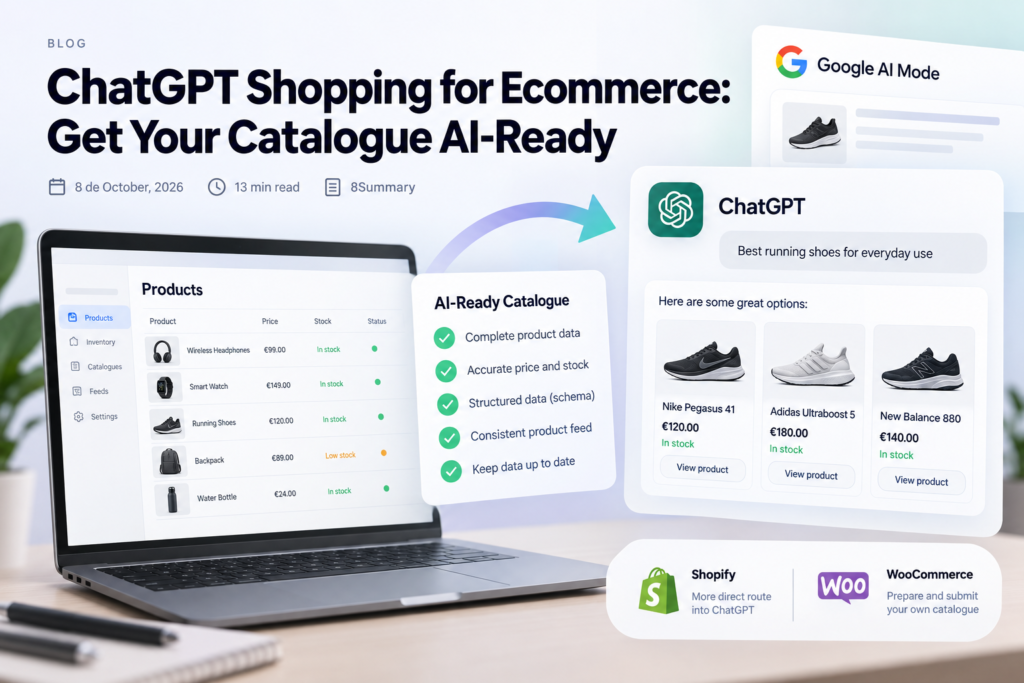
To get your products into ChatGPT and Google AI Mode, your shop needs a catalogue with complete product data, price and stock that are always up to date, structured data on product pages and a consistent product feed. Discovery in AI answers is possible from Europe today; buying inside ChatGPT should not be your priority yet.
- Appearing in AI answers (discovery) and selling inside ChatGPT (checkout) are separate projects: discovery is already within reach for European shops.
- Shopify stores have a more direct route into ChatGPT; WooCommerce stores have to prepare and submit their own catalogue.
- Wrong or outdated price and stock data is the fastest way to be ignored and to lose customer trust.
- The same data work serves ChatGPT, Google and traditional SEO, so the investment is not wasted.
- Measure AI referral traffic in GA4 before deciding to spend more.
A buyer asks ChatGPT for the best office coffee machine under a certain budget. The answer shows three shops, and none of them is yours. There is no bid to raise and no position to buy, and you probably never find out that the sale was lost. ChatGPT shopping for ecommerce has turned product visibility into a question of catalogue data, not advertising budget.
The short answer: your products appear in ChatGPT and Google AI Mode answers when your catalogue has complete titles and attributes, up-to-date price and stock, reviews, shipping and returns information, structured data on product pages and a consistent feed. Discovery already works for shops in the UK and the EU. Buying inside ChatGPT should not be your priority yet.
What does ChatGPT shopping for ecommerce actually mean?
It means that when someone asks an AI assistant for a buying recommendation, your products can appear in the answer with name, price, image and a link to your shop. Five terms are worth knowing before you spend anything:
- A product feed is a file listing your full catalogue (name, price, stock, image, barcode) that your shop sends to a platform, a core requirement for ChatGPT shopping for ecommerce, as detailed in the ChatGPT product feed specification.
- Structured data (Product schema) is invisible code on product pages that tells machines, without ambiguity, what the product is, what it costs and whether it is in stock, essential for ChatGPT shopping for ecommerce to work correctly.
- Instant Checkout is OpenAI’s feature that lets a user complete a purchase without leaving ChatGPT, as explained in the OpenAI Help Centre.
- The Agentic Commerce Protocol (ACP) is the open protocol behind Instant Checkout. It defines how a shop and an AI assistant exchange order data.
- Google AI Mode is Google’s search mode in which the answer is generated by AI rather than shown as a list of links.
The decisive distinction is between discovery and checkout. Discovery is being recommended in the answer. Checkout is selling inside the conversation. They are two different projects, with different costs and timelines.
Is ChatGPT shopping for ecommerce available in the UK and Europe?
Being recommended, yes. Selling inside ChatGPT, probably not yet. A shop in the UK, the Netherlands, Austria, Denmark or Finland can work on discovery today, making sure its products are found and recommended. According to OpenAI’s public information at the time of writing, Instant Checkout launched in the United States. We have not been able to confirm availability for European merchants and shoppers.
Status at publication: product discovery in ChatGPT — possible for UK and EU shops. Instant Checkout — launched in the US; European availability to be confirmed. Shopping in Google AI Mode across European markets — to be confirmed. Before paying for any checkout integration, check the current status on OpenAI’s and Google’s official pages.
There is another point that matters to whoever controls the budget. OpenAI’s Help Center states that product results in ChatGPT are not ads and are not influenced by partnerships. Merchants are ranked on availability, price, quality and whether they make or primarily sell the item. Visibility cannot be bought: it is earned with better data.
Why doesn’t my shop appear in ChatGPT shopping for ecommerce results?
In most cases, your shop is missing because the assistant cannot read, confirm or trust your product data. The product itself is rarely the problem; how the information is published almost always is. Run this quick self-diagnosis:
- Are product titles generic (“Model X”) rather than descriptive (brand, type, size, colour, material)?
- Are attributes such as dimensions, compatibility or composition missing?
- Do products lack a GTIN (the barcode number) or a manufacturer part number?
- Do price or stock on your site differ from Google Shopping or other channels, a mismatch that quickly undermines ChatGPT shopping for ecommerce?
- Are product pages missing structured data, or does it contain errors?
- Are customer reviews missing from product pages?
- Are shipping costs and returns policy hidden or vague?
- Is your shop on WooCommerce and has never submitted its catalogue to any AI platform?
If you answered “yes” to three or more, your catalogue is not ready for AI shopping. The good news is that each point can be fixed, and every fix also improves traditional SEO. This article covers the catalogue only; content and brand authority are a separate part of SEO and generative engine optimisation (GEO).
ChatGPT shopping for ecommerce vs Google AI Mode: how do products get in?
Both rely on product data, but they reach it by different routes. The table summarises what is known and what still needs confirming.
| Criterion | ChatGPT | Google AI Mode |
|---|---|---|
| Data source | Feed submitted by the merchant (or Shopify Catalog) and public web pages | Google’s product data, fed by Google Merchant Center and your site’s pages |
| How to get in | Shopify stores: via Shopify Catalog. Others: apply for direct feed access | Consistent feed in Google Merchant Center and correct structured data |
| Ads or organic | Organic product results, according to OpenAI | To be confirmed for AI Mode in European markets |
| European status | Discovery possible; checkout to be confirmed | To be confirmed |
| In-platform checkout | Instant Checkout, launched in the US | To be confirmed |
The practical conclusion is simple: the groundwork is the same. A clean catalogue, with consistent data across site, feed and Merchant Center, serves both platforms. There is no need to run two projects.
Checklist: an AI-ready product catalogue for ChatGPT shopping for ecommerce
Use this checklist to assess whether your catalogue is prepared. It is ordered by priority, so start at the top.
- Price and stock synced in real time. This is the foundation of ChatGPT shopping for ecommerce: a product recommended as available that turns out to be sold out costs you the sale and the customer’s trust.
- Descriptive titles. Brand + product type + main attribute + variant. Write the way customers ask.
- Complete attributes. Size, colour, material, dimensions, compatibility, target user. In ChatGPT shopping for ecommerce, AI compares attributes; if they are missing, the product drops out of the comparison.
- GTIN and manufacturer part number. These identify the product unambiguously across shops.
- Useful descriptions. What it is for, who it suits, what sets it apart. No text copied from the supplier.
- Visible reviews. OpenAI, on its merchant page, says ChatGPT weighs reviews when presenting options, another factor that shapes ChatGPT shopping for ecommerce results.
- Clear shipping and returns. Delivery times, costs and conditions per market, on every product page and in the feed, with VAT-inclusive prices in the correct currency (euros or pounds).
- Error-free Product structured data. Price, currency, availability, reviews and GTIN in the page code, validated with Google’s structured data guidelines, a step that is essential for ChatGPT shopping for ecommerce to work correctly.
- A Google Merchant Center feed consistent with the site. The same prices, titles and stock everywhere.
- An application for OpenAI’s direct feed (if you are not on Shopify), following a setup guide for merchants, once the points above are fixed.
| Block | Points | Typical effort | When |
|---|---|---|---|
| Data foundations | 1, 4, 8, 9 | Technical; depends on platform and ERP | Now |
| Catalogue content | 2, 3, 5, 7 | Editorial; scales with the number of products | Now, starting with best-sellers |
| Trust | 6 | Ongoing review-request process | Now |
| AI channels | 10 | Application and feed setup | After the foundations |
| Checkout inside ChatGPT | — | Technical integration | When available in your market |
If you have hundreds or thousands of products, do not try to fix everything at once. Start with the products that generate the most revenue and margin. That is where an AI recommendation is worth the most money.
WooCommerce or Shopify: which path into ChatGPT?
On Shopify, products reach ChatGPT through Shopify Catalog with no extra work, according to OpenAI. On WooCommerce, the shop has to prepare and submit its own catalogue. Many European SMEs run WooCommerce, and this is exactly where they fall behind without noticing.
Shopify stores
Access exists, but data quality is still your responsibility. A poorly described product enters the catalogue and loses every comparison. Apply the checklist anyway.
WooCommerce stores
A WooCommerce ChatGPT integration means generating a feed from the shop (usually with a feed plugin or a custom solution), making sure price and stock update automatically and validating the structured data on product pages. Then you submit the feed to Merchant Center and apply for OpenAI’s direct feed. If stock lives in a separate ERP, synchronisation is the most delicate part, and it is worth reviewing your ecommerce setup and integrations before sending incorrect data anywhere.
If you are unsure what state your catalogue is in, we can map it for you in a free consultation focused on getting your shop ready for AI shopping.
How do I track sales from ChatGPT shopping for ecommerce and other AI assistants?
Track referral traffic from AI assistants in Google Analytics 4 (GA4) and connect it to conversions. Without measurement, there is no way to know whether the investment pays off.
- In GA4, open the traffic acquisition report and filter session source by domains such as chatgpt.com, perplexity.ai, copilot.microsoft.com and gemini.google.com.
- Create a custom channel group called “AI assistants” with those sources, so they are separated from generic referral traffic.
- If the feed allows links with UTM parameters (tags in the URL that identify where a visit came from), use them to isolate visits from the catalogue.
- Review sessions, conversion rate and revenue from ChatGPT shopping for ecommerce for this channel every month.
Some AI visits will show up as direct traffic, and under the GDPR visitors who decline analytics cookies will not be fully recorded, so your figures will always be an underestimate. If you need this tracking set up properly, data analysis and BI support can configure GA4 to separate the channel.
Common mistakes when preparing a catalogue for ChatGPT shopping for ecommerce
- Paying for checkout integrations before they are available in your market. That is money sitting idle.
- Submitting a feed with outdated prices. Being present with wrong data is worse than not being present.
- Treating the feed as a one-off project. The catalogue changes every week; the feed behind ChatGPT shopping for ecommerce must follow automatically.
- Copying supplier descriptions. Dozens of shops will have identical text, with nothing to set you apart.
- Ignoring shipping and returns. They drive customer decisions, and therefore AI recommendations too.
- Not measuring. Without GA4 data, the decision to invest more is left to gut feeling.
Should you invest in ChatGPT shopping for ecommerce now or wait?
Invest in catalogue quality now and wait on checkout. Data work does not depend on any single platform: it improves Google Shopping, rich results, product-page SEO and conversion on your own site. Even if AI shopping moves more slowly than the headlines suggest, the money is not lost.
Early adoption of Instant Checkout was slow, largely because of the requirement to sync stock and price in real time. That confirms the priority: shops that fix their data first will be ready when the feature reaches Europe. If you have had bad experiences with agencies, ask for a plan with two columns, “do now” and “wait”, a fixed scope and metrics agreed from the start.
How onOrbit Marketing can help
onOrbit Marketing is a Portugal-based agency working with online shops across Europe, with an English-speaking team in the same time zone as the UK. We prepare catalogues to be found by Google and AI assistants in four stages. In Diagnosis, we audit your feed, structured data, price and stock synchronisation and GA4 tracking, and identify the products with the biggest revenue impact. In Strategy, you get a prioritised plan separating what to do now from what should wait for European availability. In Implementation, we set up the feed on WooCommerce or Shopify, fix Product schema, align Google Merchant Center and optimise titles and attributes. In Optimisation, we track AI referral traffic and refine the catalogue. You get a fixed scope, clear reporting and a catalogue that serves every channel.
Frequently asked questions
Does ChatGPT shopping for ecommerce show products from European shops?
It can. Product discovery in ChatGPT is not limited to US retailers: the assistant recommends products from submitted feeds and public web pages. A shop in the UK, the Netherlands, Austria, Denmark or Finland with complete, up-to-date data can appear in answers. What is not yet confirmed for Europe is buying inside ChatGPT through Instant Checkout, which launched in the US. Check OpenAI’s official pages for the current status.
Can I pay to rank my products higher in ChatGPT shopping for ecommerce results?
Not in product results. According to OpenAI’s Help Center, those results are not ads and are not influenced by partnerships. Ranking considers availability, price, quality and whether the merchant makes or primarily sells the item. OpenAI’s product specification does include separate fields for ads, but organic visibility in shopping answers still depends on the quality and accuracy of your catalogue data.
How do I join the ChatGPT merchant program if I’m not on Shopify?
Merchants outside Shopify can apply to OpenAI for direct product feed access. Before applying, make sure your feed is complete and reliable: descriptive titles, full attributes, GTINs where available, real-time price and stock, and shipping and returns details. Applying with a weak feed gains little, because ranking depends on data quality. Treat the application as the last step after fixing your catalogue foundations.
Do all my products need a GTIN?
It is not mandatory in every case, but it is strongly recommended whenever a product has a barcode. The GTIN lets platforms identify the same product across shops and compare price and availability. Handmade or made-to-order products may not have one. In that case, compensate with brand, an internal reference and detailed attributes that clearly distinguish the item from similar products.
Can a small shop compete with large marketplaces in AI answers?
Yes, especially in niches. AI assistants value complete data, competitive prices, reviews and whether the shop makes or primarily sells the product. A specialist shop with detailed descriptions, attributes that marketplaces leave empty and clear shipping information can be the best answer to specific questions. Size matters less than data accuracy, which is where focused SMEs often have an advantage.
Find out if your catalogue is ready for ChatGPT and Google
In a free consultation, we review your product feed, structured data and price and stock synchronisation. You leave with a clear list of what to fix now and what can wait, with no commitment.

Alona Stepanova
CEO of onOrbit Marketing | Web Developer & Specialist in E-commerce Growth. Helps SMEs and online stores in Portugal and across Europe grow with web development, SEO, GEO and digital marketing.